

Free cash flow (FCF) is the cash a company generates from its operations after paying for capital expenditures. The basic calculation is operating cash flow minus capital expenditures. Investors use it to assess whether a business can finance expansion, reduce debt, or eventually return cash to shareholders without constantly raising new capital.
A negative FCF number is not automatically bad. In 2026, large AI infrastructure investments pushed Amazon, Alphabet, and Meta below zero on this measure, even as their operations produced substantial cash. The distinction matters: weak operations and aggressive investment can produce the same negative headline for very different reasons.
What Is Free Cash Flow?
Operating cash flow is the cash generated by a company’s main business, after customer collections, supplier and employee payments, taxes, interest under U.S. GAAP classification, and changes in working capital. Capital expenditures, or CapEx, are cash investments in long-lived assets such as factories, servers, data centers, and equipment.
FCF subtracts the latter from the former. Unlike net income, which includes accruals and noncash expenses, this calculation tests whether current operations cover the cash cost of investment. It is not the same as the change in a company’s bank balance.
The SEC explains that FCF is a non-GAAP measure without one uniform definition. Companies must explain their calculation and reconciliation. FCF also does not necessarily equal cash available for discretionary spending because debt repayments, acquisitions, and other obligations may remain.
Free Cash Flow Formula and a Simple Example
Free cash flow = Cash flow from operations − Capital expenditures
Suppose a hypothetical manufacturer reports the following for one fiscal year, with all amounts in U.S. dollars:
| Cash flow component | Hypothetical amount |
|---|---|
| Cash generated by operating activities | $120 million |
| Cash spent on property and equipment | $75 million |
| Free cash flow | $45 million |
The calculation is $120 million − $75 million = $45 million. The company funded its reported capital spending from operations and retained a positive $45 million under this simplified definition. That does not mean it can distribute the entire amount: debt maturities, acquisitions, or other commitments might still require cash.
Where to find the two inputs
Open a U.S.-listed company’s Form 10-K or 10-Q and locate its statement of cash flows. Find “net cash provided by operating activities.” Then look under investing activities for “purchases of property and equipment” or similar capital-spending lines. If management publishes an FCF reconciliation, compare it with your calculation.
Check the unit label first. A table presented “in millions” turns 42,422 into $42.422 billion, not $42,422 billion. Also check the period: many 10-Q cash flow statements report six or nine months year-to-date, whereas income statements often include a separate three-month column. Subtract earlier year-to-date figures to isolate a quarter when necessary. Our guide to reading quarterly earnings explains how to avoid these reporting-period errors.
The Magnificent Seven: When Free Cash Flow Turns Negative
The Magnificent Seven are Apple, Microsoft, Alphabet, Amazon, Meta Platforms, Nvidia, and Tesla. They do not all have negative FCF. What changed in 2026 is that several major AI infrastructure spenders are paying for data centers, servers, and related equipment faster than they generate operating cash in individual quarters.
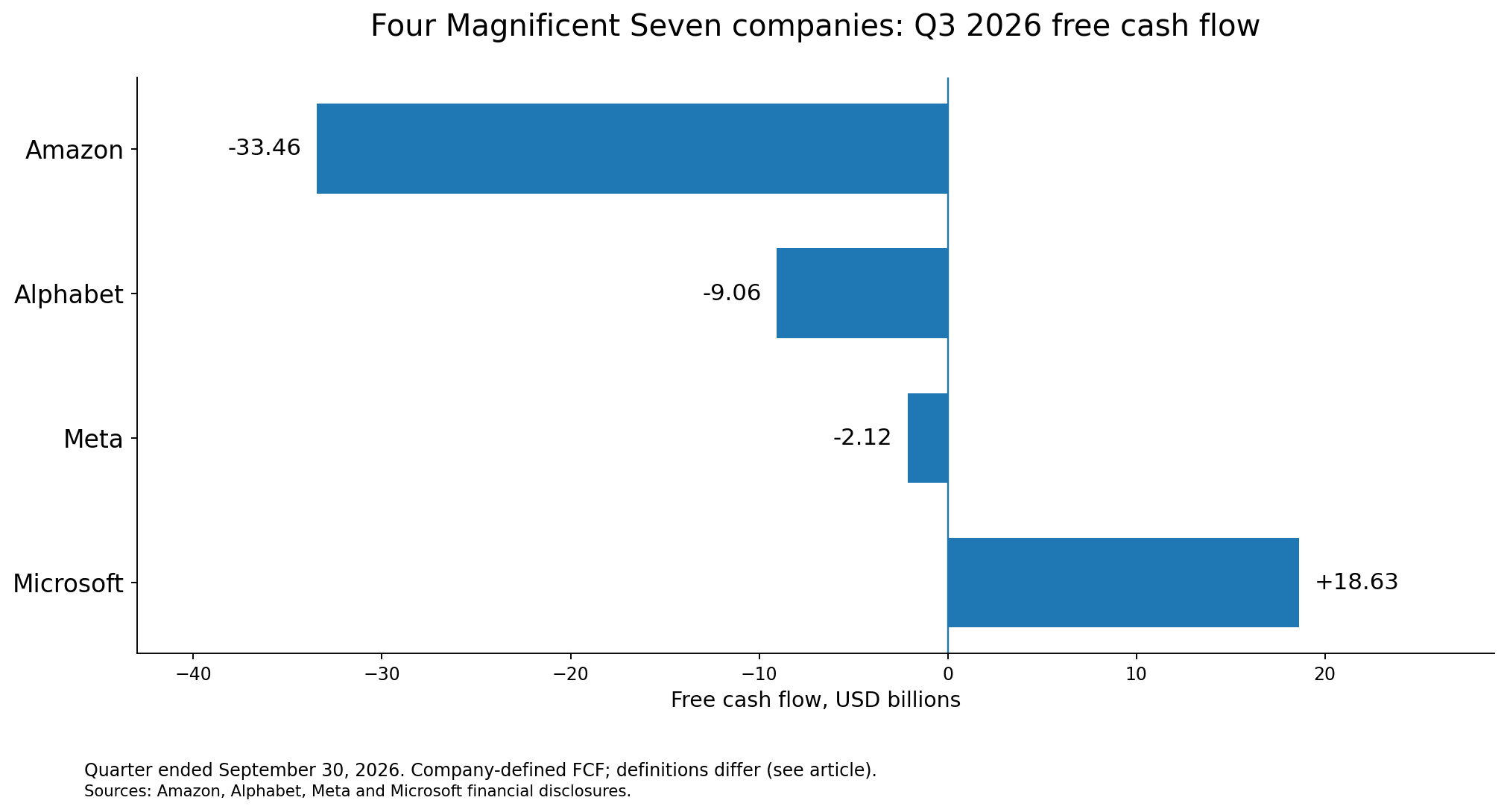
Below are four companies’ figures for the three months ended September 30, 2026, drawn from their actual cash flow statements or management reconciliations. All dollar figures are USD billions; negative FCF is shown with a minus sign.
| Company | Operating cash flow | CapEx deducted | Free cash flow |
|---|---|---|---|
| Amazon (AMZN) | 42.422 | 75.878 | −33.456 |
| Alphabet (GOOGL/GOOG) | 42.290 | 51.355 | −9.065 |
| Meta (META) | 32.786 | 34.906 | −2.120 |
| Microsoft (MSFT) | 58.000 | 39.367 | +18.633 |
Important comparability note: these values follow each company’s disclosed definition. Amazon deducts property-and-equipment purchases net of sale proceeds and vendor incentives; Meta also deducts finance-lease principal payments; Microsoft deducts cash additions to property and equipment, while separate finance-lease commitments are not included in that cash purchase line. Therefore, identical labels do not guarantee identical economic coverage. Sources: Amazon 10-Q, Alphabet 10-Q, Meta earnings release, and Microsoft earnings release.
Amazon: Negative FCF despite growing operating cash flow
Amazon provides the clearest example. In Q3 2026, operating activities generated $42.422 billion, but net cash capital spending was $75.878 billion. Its quarter-only FCF was therefore −$33.456 billion. This is calculated from its 10-Q and its disclosed definition, rather than from a price chart.
More importantly, its reported trailing-twelve-month FCF was −$42.357 billion as of September 30, 2026, versus +$14.788 billion one year earlier. Across that year, operating cash flow reached $168.300 billion, but net purchases of property and equipment reached $210.657 billion. Amazon attributed the jump in spending primarily to AI-related investment. The operating business generated more cash year over year; investment spending grew faster. These figures come from Amazon’s September 2026 10-Q reconciliation.
Alphabet: A negative quarter is not necessarily a negative year
Alphabet generated $42.290 billion of operating cash flow in Q3 2026 against $51.355 billion of capital expenditure. That yields −$9.065 billion of FCF. Its prior quarter was negative as well, but the company still had approximately +$19.747 billion over the trailing twelve months, based on the four quarterly FCF reconciliations. The duration of a cash shortfall matters as much as the headline sign.
Alphabet also reported that technical infrastructure drove capital spending. An analyst should assess whether growth in Google Cloud and other businesses can ultimately produce a satisfactory return on these assets. See Alphabet’s Q3 2026 filing.
Meta: Include lease payments when interpreting its FCF
Meta reported $32.786 billion in operating cash flow, $33.942 billion in property-and-equipment purchases, and $0.964 billion in finance-lease principal payments for Q3 2026. Thus, $32.786 − $33.942 − $0.964 = −$2.120 billion in its reported FCF.
The company forecast $135–$145 billion in 2026 capital expenditures including finance-lease principal payments. Whether those investments eventually improve advertising, AI services, and other business returns cannot be judged from the quarter’s FCF alone. Read the reconciliation and outlook in Meta’s release.
Microsoft and the others: Avoid treating the whole group as one company
Microsoft remained FCF-positive: $58.000 billion of operating cash flow less $39.367 billion of cash additions to property and equipment equaled +$18.633 billion in its fiscal Q1 2027, which ended September 30, 2026. Management separately described $45.2 billion of broader CapEx, including finance leases, showing why cash-flow and investment definitions must be checked.
Other Magnificent Seven members also demonstrate differences. Nvidia reported +$21.341 billion of FCF for its fiscal Q2 2027 ended July 26, 2026, under its own reconciliation. Apple’s fiscal year ended September 26, 2026 generated $145.097 billion of operating cash against $9.041 billion of property-and-equipment payments, or approximately +$136.056 billion under the simplified annual formula. Tesla reported a positive Q3 2026 FCF as well. These are different reporting periods, so they should not be ranked directly against the four-company quarterly table. See Nvidia’s results and Apple’s filing.
Why Investors Care About Free Cash Flow
1. It tests whether growth is self-funded
Profits can rise while cash needs grow even faster. Persistently negative FCF means a company must draw down cash reserves, sell assets, borrow, issue shares, or otherwise find funding. The balance sheet determines how long that pattern can continue. Investors should compare cash, liquid investments, debt, maturities, and access to capital with the projected spending program.
2. It exposes investment intensity and potential returns
CapEx may build productive assets rather than represent a loss. A data center can generate revenue for years, while its purchase cost appears immediately in cash flow and gradually as depreciation in earnings. The key question is whether incremental future operating cash will justify today’s spending. Evaluate revenue growth, operating margins, asset utilization, and return on invested capital rather than assuming all CapEx is beneficial.
3. It informs valuation, but not by itself
Forecast free cash flow is central to discounted cash flow (DCF) valuation: investors estimate future cash flows, apply a discount rate reflecting risk, and calculate their present value. However, the simple operating cash flow minus CapEx metric is not identical to formal free cash flow to the firm (FCFF) or free cash flow to equity (FCFE). The CFA Institute’s free cash flow valuation framework distinguishes the two and their appropriate discount rates.
An FCF yield can be calculated as annual FCF divided by market capitalization, but only with a consistent definition and appropriate leverage considerations. A negative one-quarter yield cannot establish that a stock is overvalued, just as a positive yield is not proof of a bargain. For complementary measures, see our financial ratios guide.
How to Interpret Negative FCF: A Five-Question Checklist
- Is operating cash flow itself negative? That may suggest a different problem from positive operations overwhelmed by investment spending.
- Is CapEx maintenance or expansion? Repairing existing assets is harder to defer than optional capacity expansion. Companies do not always disclose an exact split.
- Does the shortfall persist? Compare quarterly, year-to-date, trailing-year, and multi-year results, adjusting for seasonality and one-time cash movements.
- What is funding the gap? Check cash balances, new debt, equity issuance, leases, liquidity facilities, and future interest or principal obligations.
- Are returns becoming visible? Watch future operating cash, revenue, margins, and utilization relative to capital deployed.
Cash conversion problems deserve a separate investigation. Our guide to cash flow warning signs covers receivables, inventory, supplier terms, and recurring dependence on financing.
Common Free Cash Flow Mistakes
- Using net income instead of operating cash flow. Net income includes accruals and noncash expenses.
- Subtracting all investing cash flow as CapEx. Securities purchases and acquisitions are not necessarily ordinary capital spending.
- Mixing quarterly and annual numbers. In particular, a Q3 10-Q often has nine-month cumulative cash flows.
- Ignoring finance leases and stock-based compensation. Lease-financed infrastructure may not appear immediately as cash CapEx, and adding back stock compensation in CFO does not eliminate dilution.
- Assuming negative FCF is always distress. Expansion may explain it, but growth projects can still destroy shareholder value if returns are inadequate.
Key Takeaways
Calculate FCF by subtracting capital expenditures from operating cash flow, using matching reporting periods and the issuer’s exact definition. A positive number suggests current operations cover the measured investment spending; a negative number means they do not during that period. Neither result is a complete assessment of financial health.
Amazon’s negative trailing-year FCF, Alphabet’s negative recent quarters, Meta’s lease-adjusted shortfall, and Microsoft’s positive FCF illustrate the core lesson: the quality, funding, timing, and eventual return of capital expenditures matter more than whether one quarterly number has a minus sign.
Educational note: Company data reflects disclosures available through November 7, 2026. Company-reported figures are historical facts; future AI returns are uncertain. This article is for financial education, not individualized investment advice.