

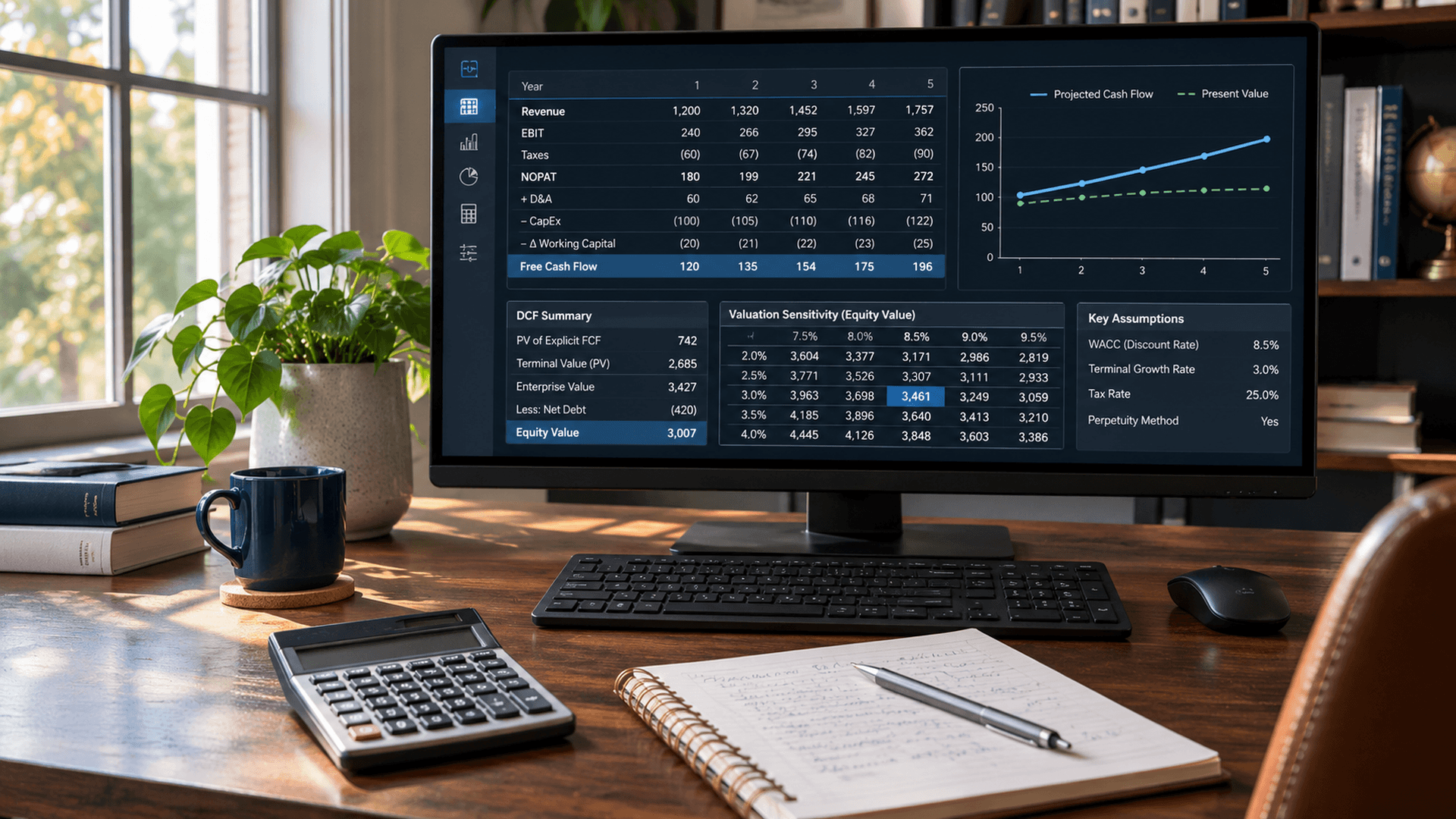
The best stock valuation software depends on whether you need a quick intrinsic-value estimate, an editable discounted cash flow (DCF) model, or financial data for your own analysis. Alpha Spread is useful for a quick valuation screen. Fiscal.ai and Finbox offer more ways to examine assumptions. Morningstar Investor provides analyst-based fair-value estimates, while Microsoft Excel gives you full control over the model.
This guide compares nine tools for U.S. fundamental investors, finance students, and analysts. Subscription prices reflect published U.S. rates as of November 10, 2026. A monthly price tied to annual billing requires an annual commitment. For the underlying valuation method, see our step-by-step DCF valuation guide.
Best stock valuation and DCF software: comparison table
| Platform | Best for | Valuation capabilities | Published U.S. price or access |
|---|---|---|---|
| Alpha Spread | Fast intrinsic-value estimates | Automated DCF and editable calculator | Free: 3 stocks/week; Premium $12/month billed annually |
| Fiscal.ai | Data-driven custom models | DCF and reverse-DCF templates | Pro $39/month billed annually; 7-day trial |
| Finbox | Multiple valuation methods | DCF, dividend and comparable-company models | Check vendor for current pricing |
| GuruFocus | Value-investing research | DCF and weighted average cost of capital calculators | U.S. membership listed at $549/year; plan selection affects price |
| Morningstar Investor | Analyst-assessed fair value | Analyst-built DCF-based fair-value estimates | $249/year or $34.95/month |
| Simply Wall St | Visual stock reports | Automated DCF-based fair value | Free: 5 company reports/month; check paid-plan pricing |
| TIKR | Fundamentals and scenario targets | P/E-based valuation builder | Free tier; Plus $17.95/month billed annually |
| Koyfin | Financial data, peers and dashboards | Financial inputs for DCF models; no dedicated DCF engine | Free tier; Plus $39/month billed annually |
| Microsoft Excel | Fully auditable custom valuations | Build cash-flow models from scratch | License cost varies; market data separate |
The main selection criteria are valuation methodology, flexibility of assumptions, financial-data coverage, auditability and subscription cost.
Which valuation platforms are worth considering?
1. Alpha Spread: best for a fast DCF assessment
Alpha Spread calculates intrinsic-value estimates and presents model assumptions alongside bear, base and bull scenarios. Its official pricing page lists three free stock valuations per week, Premium at $144 per year ($12 per month equivalent), and Unlimited at $240 per year ($20 per month equivalent).
The convenience comes with a trade-off: automatically generated revenue forecasts and terminal-value assumptions may differ from your own assessment of the business. Examine those inputs before relying on the estimated fair value.
2. Fiscal.ai: best for building and stress-testing a DCF
Fiscal.ai, formerly FinChat, introduced updated DCF, reverse DCF, internal rate of return and comparable-company templates in July 2026. Its models start with company financial data. The help center lists Pro at $49 month to month or $39 per month with annual billing, and Max at $99 month to month or $79 per month with annual billing. The seven-day trial requires a payment card and converts to a paid plan unless canceled.
A reverse DCF works backward from the market price to estimate the future cash-flow growth needed to justify that price. This helps investors evaluate the expectations already reflected in a stock’s valuation.
3. Finbox: best for comparing several valuation methods
Finbox supports discounted cash flow, comparable-company and dividend discount models. Its financial-model guide explains when specific methods are disabled for certain businesses. For example, the standard unlevered DCF approach is generally unsuitable for banks.
Before subscribing, check the price, company coverage, editable assumptions and model-export options for the plan you intend to use.
4. GuruFocus: best for value investors seeking historical context
GuruFocus offers free-cash-flow-based DCF estimates, discount-rate calculations, historical financial statements and stock screens. Its pricing page lists a U.S. regional membership at $549 per year. The final amount depends on the region and membership selected.
Historical valuation ratios and profitability metrics help put an intrinsic-value estimate in context. Investors should still test the growth, reinvestment and discount-rate assumptions behind the forecast.
5. Morningstar Investor: best for an analyst-based fair-value estimate
Morningstar analysts use discounted cash flow models to assess stock fair value. Morningstar Investor is listed at $249 annually or $34.95 monthly. Its main benefit is access to an analyst’s assessment of company prospects, uncertainty and competitive positioning.
Use Morningstar’s valuation as a comparison point for your own assumptions. Investors seeking a fully editable spreadsheet model will need a different workflow.
6. Simply Wall St: best for visual valuation reports
Simply Wall St combines an automated DCF fair-value estimate with financial-health indicators, relative valuations and visual company reports. Its plans page lists five company reports monthly on Free, 30 on Premium and unlimited reports on the highest tier. Check the checkout price for the paid plan you select.
The visual presentation makes it easier to identify areas for further research. The underlying discount rate, earnings quality, debt burden and share dilution still determine how useful the result is.
7. TIKR: best for earnings forecasts and P/E-based scenarios
TIKR includes historical financials, analyst estimates, transcripts, screens and a scenario-based valuation builder. According to its valuation model documentation, the builder currently uses price-to-earnings (P/E) multiples rather than a full free-cash-flow DCF. Users can adjust revenue, profit margins, share count and exit P/E assumptions. Its pricing page lists a free tier and Plus from $17.95 per month with annual billing.
TIKR is particularly useful for building earnings-based scenarios alongside a separate DCF model. Our P/E versus EV/EBITDA guide explains why different valuation multiples can produce different conclusions.
8. Koyfin: best for financial data and peer comparisons
Koyfin specializes in financial research, company comparisons and customizable dashboards. Its pricing page lists a Free plan, Plus at $39 per month with annual billing, and Premium at $79 per month with annual billing. Plus includes 10 years of financials and estimates, while Premium adds custom formulas and financial templates.
Its financial histories and consensus estimates can support a DCF forecast, but the investor must still construct the projected cash flows, terminal value and equity-value adjustments.
9. Microsoft Excel: best for building a fully auditable DCF
Excel lets analysts control revenue forecasts, operating margins, reinvestment, discount rates, terminal growth and sensitivity tables. To build a sound valuation, start with company 10-K and 10-Q filings on SEC EDGAR, then reconcile the inputs with the cash-flow statement and balance sheet. Our 10-K analysis guide explains how to find the relevant figures.
Check spreadsheet formulas carefully. Mixed currencies, inconsistent units, incorrect forecast dates and broken cell references can materially change the final per-share estimate.
How to test any DCF tool before paying
A credible DCF model should identify the cash flow being discounted and show how the valuation reaches the value of common equity. In an enterprise DCF, free cash flow to the firm (FCFF) is discounted at the weighted average cost of capital (WACC). Enterprise value is then adjusted for net debt and other financial claims to calculate equity value. Free cash flow to equity (FCFE), by contrast, is generally discounted at the cost of equity. The CFA Institute’s free cash flow valuation framework sets out these approaches.
Hypothetical example: Assume FCFF of $100 million, $110 million, $121 million, $133.10 million and $146.41 million in years one through five. Use a WACC of 10%, perpetual cash-flow growth of 3%, net debt of $250 million and 50 million diluted shares.
Formula: Enterprise value = sum of [FCFF in year t / (1 + WACC)^t] + [year-five FCFF × (1 + g) / (WACC − g)] / (1 + WACC)^5. Equity value per share = (enterprise value − net debt) / diluted shares, assuming no other equity adjustments.
Discounting the five annual cash flows produces $454.55 million. The terminal value, discounted to the present, adds $1,337.66 million. Enterprise value is therefore $1,792.21 million. Subtracting $250 million in net debt gives $1,542.21 million in equity value, or $30.84 per diluted share.
| Assumed WACC | Estimated equity value per share | Other assumptions |
|---|---|---|
| 9% | $37.01 | Same cash flows, 3% perpetual growth, debt and shares |
| 10% | $30.84 | Same inputs |
| 11% | $26.22 | Same inputs |
Increasing WACC from 9% to 11% reduces the model’s estimated equity value from $37.01 to $26.22 per share. At a 10% WACC, the discounted terminal value accounts for approximately 75% of enterprise value. That concentration makes the valuation especially sensitive to long-term growth and discount-rate assumptions.
What valuation software cannot solve
Valuation accuracy depends on the quality of the cash-flow forecast. Reconcile net income, operating cash flow, capital expenditures and working-capital changes before projecting future results. Our free cash flow guide explains the basic calculation. Operating cash flow minus capital expenditures is a useful starting point, but enterprise DCF models require the appropriate FCFF adjustments.
Different businesses also require different forecasting approaches. A capital-intensive company may generate strong revenue growth while cash flows remain constrained by new investment. Financial firms require sector-specific methods because debt and regulatory capital play a different role in their operations. Compare cash-flow definitions consistently, especially when company presentations emphasize adjusted or non-GAAP figures.
Finally, examine how changes in interest rates affect your discount rate. A higher WACC can substantially reduce the present value of cash flows expected many years into the future, particularly when terminal value represents a large share of the estimated business value.
Which DCF software should you choose?
For a quick first estimate: start with Alpha Spread and examine its assumptions. For customizable models: compare Fiscal.ai and Finbox, paying particular attention to editing and export features. For an analyst perspective: use Morningstar Investor. For fundamental data and multiple-based analysis: consider TIKR, Koyfin or GuruFocus. For learning valuation in depth: build an Excel model and reconcile every material input against company filings.
In practice, a research platform paired with an auditable spreadsheet can be more useful than relying on a single automated fair-value estimate.
Last updated November 13, 2026. For educational purposes only; not investment, tax or career advice.