


Interest rates affect stock valuations by changing the return investors demand, the cost of borrowing, and expectations for future corporate cash flow. When the discount rate rises, the present value of unchanged future cash flows falls. Lower discount rates have the opposite effect. But stock prices do not automatically fall when interest rates increase, because growth expectations and risk premiums can change at the same time.
For investors, the key is to separate two questions: What happens to the valuation multiple? And what happens to the business’s earnings and cash flow? This guide explains both, then walks through a discounted cash flow (DCF) calculation.
Why Do Higher Interest Rates Usually Pressure Stock Valuations?
A stock represents a claim on a company’s future economic benefits. Money expected five or ten years from now is worth less than money received today because investors must wait and accept risk. Valuation models convert those future amounts into today’s dollars by applying a discount rate, the return required for taking that risk.
The Federal Reserve’s discussion of asset valuations identifies expected future income, risk-free rates, and risk premiums as fundamental drivers of asset prices. If expected cash flow stays fixed but the required return increases, calculated intrinsic value declines. The reverse is also true.
Higher yields on Treasury securities can also make bonds more competitive with stocks. A bond may offer a higher contractual yield, while equity still carries uncertain earnings and market prices. This does not make bonds risk-free in every sense: the SEC explains that fixed-rate bond prices generally fall when market yields rise.
Which Interest Rate Actually Matters for Stocks?
Investors often focus on the Federal Reserve’s policy rate, but a stock’s valuation is not calculated by plugging the federal funds rate directly into a formula. The relevant measures play different roles.
| Rate or measure | What it tells investors | Why it matters for valuation |
|---|---|---|
| Federal funds rate | The Fed’s short-term policy stance | Influences borrowing conditions and expectations for other rates |
| 10-year Treasury yield | A commonly used long-term U.S. benchmark | Can help anchor a dollar-denominated equity discount rate |
| Equity risk premium | Extra return investors demand for equity risk | Raises or lowers the required return beyond the Treasury benchmark |
| Corporate borrowing rate | Cost of new debt or refinancing | Can affect interest expense, investment decisions, and WACC |
The Federal Reserve explains that long-term rates reflect expected future policy and broader economic conditions, not just today’s overnight policy rate. A Fed rate cut can therefore coexist with a rising 10-year Treasury yield.
A commonly used cost-of-equity model is cost of equity = risk-free rate + beta × equity risk premium. Beta estimates sensitivity to broad equity-market risk. For example, using purely hypothetical inputs of a 4% risk-free rate, a beta of 1.2, and a 5% equity risk premium gives a 10% cost of equity (4% + 1.2 × 5%). If the risk-free rate rises, the required return may rise too, although beta and the premium need not remain fixed. NYU Stern professor Aswath Damodaran provides definitions of cost of equity and other valuation measures.
The DCF Formula: How Rates Change Intrinsic Value
A discounted cash flow model values a business from the future cash it is expected to generate. Its basic present-value formula for a cash flow received in year t is:
Present value (USD) = Future cash flow (USD) / (1 + discount rate) to the power of t
For an entire business, an analyst adds the discounted values of projected annual free cash flow to the firm (FCFF) and a terminal value representing cash flow beyond the explicit forecast. When using FCFF, the appropriate discount rate is generally the weighted average cost of capital (WACC), which reflects the financing costs of both debt and equity. After estimating enterprise value, subtract net debt and make any other necessary nonoperating adjustments to arrive at equity value.
Do not mix FCFF with the cost of equity: cash flow available only to shareholders, often called FCFE, should instead be discounted at a cost-of-equity rate. Cash flows and discount rates must also be consistent in currency and inflation terms, as discussed in Damodaran’s risk-free rate guidance.
Worked Example: A Two-Point Increase in WACC
Consider a hypothetical U.S. business. It generates $100 million of FCFF at each year-end for the next five years. Starting in year six, FCFF grows at 2% annually forever. The business has $200 million in debt, $50 million in cash, and 50 million shares outstanding. Assume a constant WACC in each scenario, with no other adjustments or changes in the cash flow forecast.
Variables and units: FCFF in years 1–5 = $100 million per year; year-six FCFF = $102 million; perpetual growth (g) = 2%; WACC (r) = 8%, 10%, or 12%; net debt = $150 million; shares = 50 million.
Terminal value at the end of year five (USD millions) = FCFF in year six / (r − g).
Enterprise value (USD millions) = sum of FCFF in years 1–5 discounted to today + terminal value discounted five years.
Equity value per share (USD) = (enterprise value − debt + cash) / shares outstanding.
At an 8% WACC, the five explicit annual cash flows have a present value of $399.27 million. Terminal value is $102 million / (8% − 2%) = $1,700 million at year five, worth $1,156.99 million today. Enterprise value is therefore $1,556.26 million. After subtracting $150 million of net debt, equity value is $1,406.26 million, or $28.13 per share.
| Hypothetical valuation (USD) | 8% WACC | 10% WACC | 12% WACC |
|---|---|---|---|
| PV of five-year FCFF ($m) | $399.27 | $379.08 | $360.48 |
| PV of terminal value ($m) | $1,156.99 | $791.67 | $578.78 |
| Enterprise value ($m) | $1,556.26 | $1,170.75 | $939.25 |
| Equity value ($m) | $1,406.26 | $1,020.75 | $789.25 |
| Equity value per share | $28.13 | $20.42 | $15.79 |
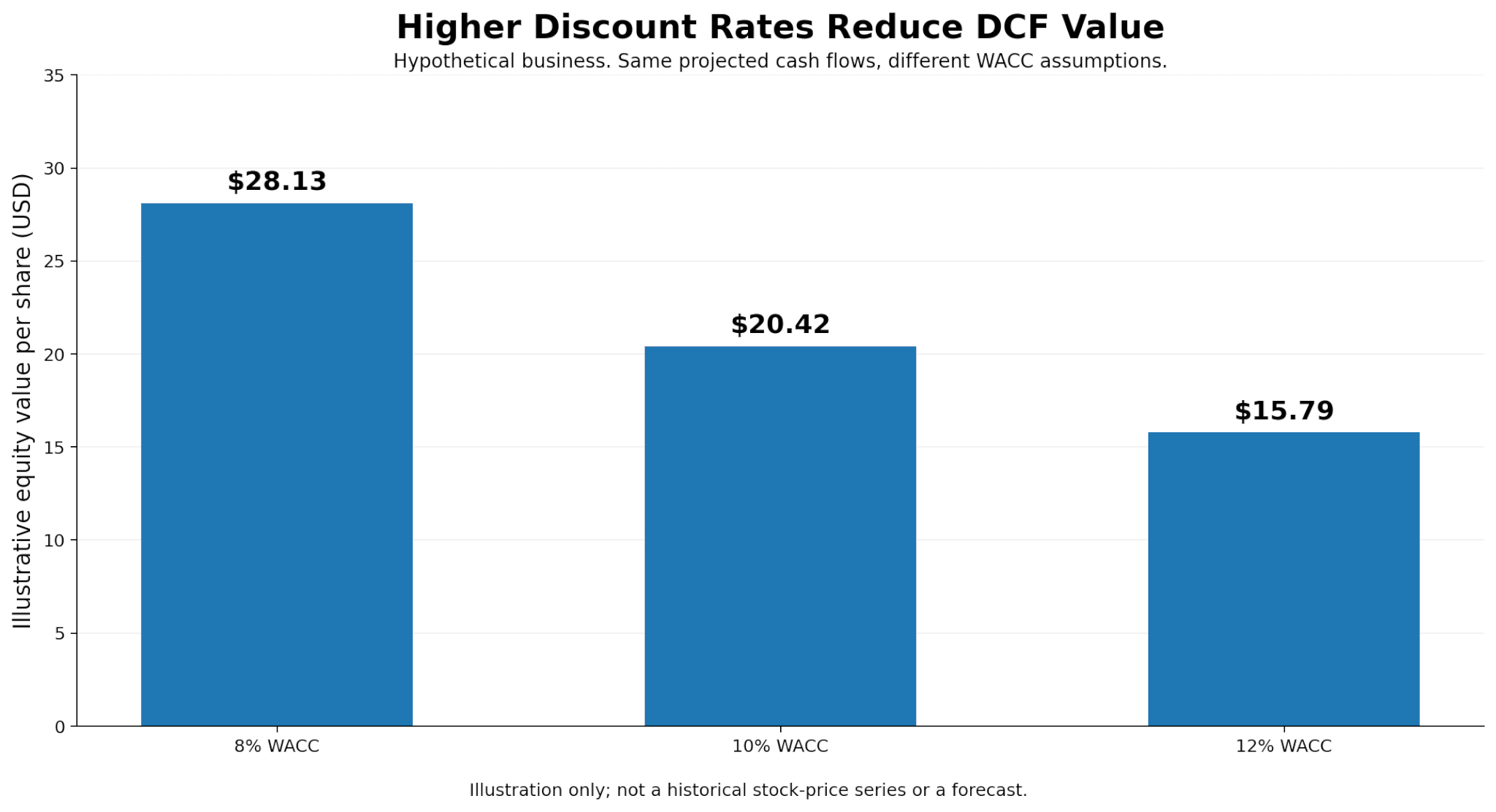
Moving from 8% to 10% WACC reduces modeled value per share by about 27.4%, even though operating cash flows do not change. This is a sensitivity test, not a prediction that a two-percentage-point increase in Treasury yields will cause a 27.4% stock-price decline. WACC does not move mechanically with one market rate, and most real forecasts would change with economic conditions.
The model is also highly sensitive to its terminal growth assumption: much of the value comes from cash flows expected after year five. For another application of discounted cash flows to investment decisions, see our NPV vs. IRR worked example.
Why Growth Stocks Often React More Sharply
Two businesses with similar current profits can have very different exposure to rates. A mature company may generate substantial cash now, while a younger growth business may be valued mainly for cash flow it expects to generate several years ahead. Distant cash flows receive a larger present-value discount when required returns rise. This is often called equity duration.
That is why some high-multiple technology or other growth companies can experience pronounced valuation pressure when long-term yields rise. It is not a universal rule. A profitable, cash-rich technology company may have less refinancing exposure than a highly leveraged mature business. Profit margins, competitive advantages, and the timing of cash generation all matter.
How Interest Rates Affect P/E Ratios
The price-to-earnings ratio (P/E) divides a share’s price by its earnings per share. Its inverse, earnings yield = EPS / share price, helps illustrate why bond yields matter to relative valuation. A stock at 25 times earnings has an earnings yield of 4%; at 20 times, the earnings yield is 5%.
For example, if a hypothetical company earns $5 per share, a 25× P/E implies a $125 share price, while a 20× P/E implies $100. That is a 20% decrease in price with unchanged EPS. Higher required returns can contribute to such multiple compression, but a Treasury yield does not dictate a specific P/E ratio.
Earnings yield is not the same as the return an investor will actually earn. Companies reinvest profits, accounting earnings differ from free cash flow, and future EPS may rise or fall. Our financial ratios guide covers how to interpret ratios alongside company fundamentals.
Interest Rates Also Change Business Earnings and Cash Flow
Discounting is only half the story. A rate change can alter the cash flows being discounted:
- Debt costs: Firms with floating-rate loans or upcoming maturities may face higher interest expense and reduced cash available to shareholders. Fixed-rate debt can delay the effect until refinancing.
- Capital spending: A higher cost of capital can make new factories, acquisitions, and expansion projects less attractive.
- Customer demand: Higher borrowing costs can weaken demand for homes, vehicles, and other financed purchases. The Fed explains this borrowing and spending channel.
- Cash balances: Companies holding significant short-term cash investments may earn more interest income as yields rise, partially offsetting other pressures.
- Sector differences: REITs, utilities, and highly leveraged companies can be especially sensitive to financing costs; banks may benefit from some rate changes but also face funding-cost, credit, and bond-portfolio risks.
When analyzing an actual business, do not stop at reported earnings. Read the debt maturity schedule, variable-rate exposure, capital expenditures, and cash flow statement. Our quarterly earnings checklist explains how to evaluate earnings quality and cash conversion.
Why Stocks Can Rise When Rates Rise, or Fall When Rates Fall
Interest rates are not the only input in a stock’s value. If Treasury yields rise because the economy is stronger and expected cash flows increase, improved earnings can offset a higher discount rate. Conversely, if yields fall because investors fear a recession, lower expected profits or a larger equity risk premium can outweigh the discount-rate benefit.
Inflation matters for the same reason. Higher nominal rates may coincide with higher expected nominal revenue, but business costs may rise too. When inflation surprises move markets, investors must separate changes in earnings expectations from changes in rates. Our guide to how U.S. inflation data moves the Nasdaq addresses that economic transmission rather than the company-level valuation model used here.
A Practical Checklist for Investors
- Track the right benchmark: Compare the current 10-year Treasury yield with the rate embedded in your long-term valuation; distinguish it from the Fed’s overnight policy setting.
- Stress-test WACC: Recalculate intrinsic value under at least three reasonable discount-rate assumptions.
- Stress-test cash flows separately: Model slower revenue, lower margins, higher interest expense, and different capital spending, rather than changing only WACC.
- Check balance-sheet exposure: Review debt maturities, cash balances, fixed versus floating debt, and expected refinancing needs.
- Compare valuation with price: A model’s intrinsic value is an estimate, not a guaranteed trading price. Consider uncertainty before interpreting apparent upside.
Frequently Asked Questions
Do rising interest rates always make stocks fall?
No. Higher rates often reduce the present value of unchanged future cash flows, but stronger economic growth, higher profits, or falling risk premiums may offset that effect.
Why are technology stocks sensitive to Treasury yields?
Many growth companies derive a large share of their valuation from distant expected cash flows, which are more sensitive to discount-rate assumptions. Exposure differs considerably across companies.
Does a Fed rate cut automatically increase stock valuations?
No. Markets may already anticipate the decision, longer-term Treasury yields may move differently, and a weak earnings outlook can overwhelm any benefit from a lower policy rate.
Key Takeaways
Rates affect both the discount applied to future cash flows and the cash flows businesses can generate. Higher discount rates tend to lower DCF values and can compress P/E multiples, especially for firms dependent on distant earnings. But the magnitude and direction of actual stock-price moves depend on growth, financing, inflation, and investor risk appetite. A sound analysis tests these variables separately instead of assuming that stocks must move opposite to interest rates.
Educational note: All company figures in the worked example are hypothetical. This article is not investment advice or a forecast of market returns.