

AI capital spending can reduce free cash flow even when a technology company is growing rapidly and reporting higher profits. The reason is timing: building AI data centers and buying processors require cash today, while the revenue and productivity benefits may arrive over several years. The investments can create long-term value, but the initial cash outflow lowers the amount left after capital expenditures.
This distinction became particularly visible in the quarter ended September 30, 2026. Meta and Alphabet spent more on capital assets than they generated from operations, while Microsoft continued to generate positive free cash flow under its reported definition. The accounting mechanics, not the stock-price movements, explain the difference.
What counts as AI capital spending?
Capital expenditures, or CapEx, are investments in long-lived business assets. For AI infrastructure, they can include servers, GPUs and other accelerators, networking equipment, data-center construction, electrical systems, and cooling facilities. Some of those assets must be replaced relatively quickly as technology advances.
Not every AI expense is CapEx. Engineers’ salaries, many software-service expenses, research costs, and day-to-day electricity and maintenance usually affect operating expenses, subject to applicable accounting rules. By contrast, capitalized equipment generally appears on the balance sheet and is depreciated over its useful life.
That timing difference matters. Paying for a server can create an immediate investing cash outflow, while the income statement recognizes its cost gradually through depreciation. The SEC’s guide to financial statements explains why accounting profit and reported cash flows answer different questions.
The free cash flow formula and the effect of AI CapEx
A widely used starting formula is:
Free cash flow (FCF) = Cash flow from operations − Cash capital expenditures.
Cash flow from operations reflects cash generated or used by ongoing business activities. Capital expenditure normally appears under investing activities in the statement of cash flows. Free cash flow is a non-GAAP measure, however, and companies may adjust the calculation for items such as principal paid on finance leases. Always read the reconciliation and use consistent definitions.
A hypothetical AI infrastructure investment
Suppose a cloud company increases sales and operating cash generation but sharply expands its infrastructure budget. All figures below are hypothetical, in billions of US dollars, for two equally long periods.
| Cash flow measure | Before expansion | During AI expansion |
|---|---|---|
| Operating cash flow | $25B | $30B |
| Cash capital expenditures | $10B | $34B |
| Free cash flow | $15B | −$4B |
Before expansion: $25B − $10B = $15B FCF. During expansion: $30B − $34B = −$4B FCF. Operating cash flow rose by $5B, or 20%, but CapEx increased by $24B, so free cash flow fell by $19B.
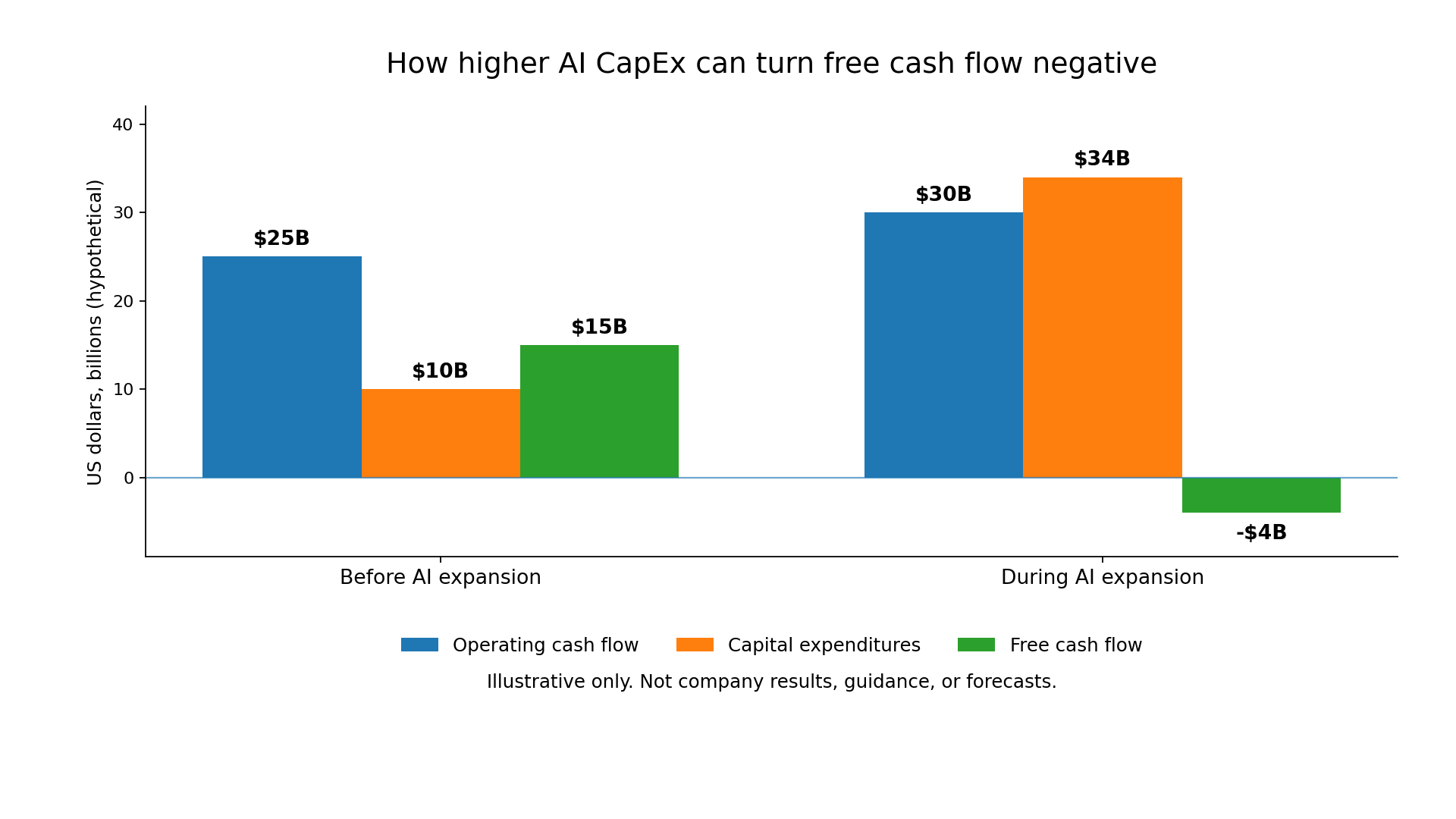
The negative number does not show whether the new data centers will earn an attractive return. It shows only that current-period cash investment exceeded operating cash generation. A full investment decision requires forecasting future customer demand, pricing, utilization, operating costs, and reinvestment needs.
Real examples: Meta, Alphabet, and Microsoft in 2026
The following figures cover the three months ended September 30, 2026, not an entire year. Values are rounded to billions of US dollars. They come from the companies’ published financial disclosures.
| Company and period | Operating cash flow | CapEx or investment cash deducted | Free cash flow | Definition used |
|---|---|---|---|---|
| Meta, Q3 2026 | $32.79B | $34.91B | −$2.12B | Meta-reported FCF; includes payments on finance leases |
| Alphabet, Q3 2026 | $42.3B | $51.4B | About −$9.1B | Simple operating cash flow less reported CapEx |
| Microsoft, fiscal Q1 2027 | $58.0B | $39.4B | $18.6B | Microsoft-reported FCF; subtracts cash paid for property and equipment |
Meta: higher infrastructure spending and negative quarterly FCF
Meta’s third-quarter earnings release reported $32.786B of operating cash flow, $33.942B of purchases of property and equipment, and $0.964B of finance-lease principal payments. Its reconciliation gives $32.786B − $33.942B − $0.964B = −$2.120B of free cash flow.
That was a marked change from positive $10.625B in the comparable 2025 quarter. Meta also reported $82.45B of cash, cash equivalents, and marketable securities at September 30, 2026. Negative quarterly free cash flow therefore should not be confused with an immediate inability to pay obligations. It does show how a large infrastructure program can absorb cash generated by a profitable core business.
Alphabet: operating cash generation below infrastructure investment
Alphabet’s third-quarter 2026 Form 10-Q reported about $42.3B in operating cash flow and $51.4B in CapEx, largely associated with technical infrastructure. Using the simple formula produces approximately −$9.1B for the quarter.
This is an analyst calculation from rounded filing figures, not a separate standardized GAAP line item. It highlights the cash demands of expansion, but it cannot by itself establish whether Alphabet’s AI investments will ultimately pay off.
Microsoft: positive FCF despite even larger announced CapEx
For its fiscal first quarter of 2027, also ended September 30, 2026, Microsoft reported $58.0B of operating cash flow, $39.4B of cash paid for property and equipment, and $18.6B of free cash flow. Its management also discussed $45.2B of capital expenditures, a broader spending measure that includes commitments recognized when finance leases begin.
It would be misleading to subtract the full $45.2B announced CapEx figure from $58.0B and call the result Microsoft’s reported FCF. Lease treatment and payment timing change which amounts enter the cash-based formula. This is why investors should check definitions before ranking companies by free cash flow.
Why negative free cash flow is not always bad
A business can generate negative FCF because it is building productive assets that may generate future cash receipts. An AI data center can require substantial construction and hardware spending before it reaches full utilization. If demand eventually fills that capacity at attractive margins, the initial outlay may support higher cash generation later.
However, the same investment can destroy value if demand disappoints, AI services become cheaper too quickly, power costs rise, or equipment becomes obsolete faster than planned. Capital spending needs can also remain high after the first construction wave because GPUs and networking equipment require replacement.
The critical distinction is between temporary investment-driven negative FCF and persistent cash consumption without sufficient returns. Other signals, such as receivable collection, debt dependence, and cash conversion, are covered in our guide to cash flow warning signs.
What AI CapEx means for valuation and shareholder returns
A company’s value depends on the cash it can produce for investors over time, not simply on its current earnings growth or number of installed GPUs. Discounted cash flow analysis estimates future free cash flows and discounts them for timing and risk.
Higher AI spending lowers near-term FCF, but it can increase enterprise value if it generates sufficiently large future operating cash flows. The outcome depends on return on invested capital, utilization, pricing, operating margins, reinvestment needs, and the discount rate. A higher required return reduces the present value of cash expected many years from now, making long-payback projects more difficult to justify.
For the project-level logic, see our worked comparison of net present value and internal rate of return. It explains why an attractive investment requires cash inflows whose present value exceeds the initial outlay, not simply strong projected revenue.
Free cash flow also affects financial flexibility. Heavy CapEx may leave less room for buybacks, dividends, debt repayment, and acquisitions. It can increase the need for external financing even when accounting earnings are improving. Still, a company with strong liquidity can choose to spend aggressively without facing an immediate solvency problem.
Five checks investors should make in earnings reports
- Separate operating cash flow from FCF. Does the core business generate more cash even as the company spends heavily on AI?
- Reconcile the CapEx definition. Identify cash property-and-equipment purchases, finance-lease commitments, and lease principal payments. Avoid mixing commitments with cash outflows.
- Compare multiple periods. One quarter’s CapEx can reflect delivery schedules or construction milestones. Review quarterly, trailing-twelve-month, and annual data on a comparable basis.
- Test the path to returns. Are AI-related sales, capacity utilization, margins, and cash generation rising sufficiently to justify the investment? Company forecasts are not guaranteed outcomes.
- Check financial flexibility. Look at cash balances, debt maturities, interest expense, lease obligations, and whether the company funds investment using debt or asset sales.
When creating a spreadsheet to forecast these items, use consistent periods and separate assumptions from historical data. Our guide to common financial modeling mistakes explains practical checks.
Frequently asked questions
Does AI CapEx reduce net income immediately?
Not necessarily. Capitalized equipment costs are generally recognized as assets first and charged to net income through depreciation over time. Operating expenses associated with AI may reduce net income sooner. Cash spending and accounting expenses therefore follow different schedules.
Is negative free cash flow a sign of financial distress?
Not by itself. Negative FCF can result from expansion, working capital needs, or operating weakness. Assess the cause, available liquidity, debt obligations, and whether future cash returns are plausible.
Is free cash flow the same as cash on the balance sheet?
No. Free cash flow measures cash generated after specified investment spending over a period. The cash balance is a stock measured at a point in time and also reflects financing, acquisitions, investment purchases, dividends, and other cash movements.
Key takeaway
AI investment can make a company’s free cash flow deteriorate while its revenue, operating cash flow, and reported profits improve. The important question is not whether CapEx is high in isolation. It is whether the company can convert that infrastructure into sustainable future cash flows that exceed the full cost of building, operating, and replacing it.