
Bond prices and yields move in opposite directions because a fixed bond payment becomes more or less attractive as the return available on comparable new bonds changes. When market yields rise, an existing fixed-rate bond must trade at a lower price to offer buyers a competitive return; when yields fall, its price generally rises.
This relationship matters in a 5% yield environment. On November 12, 2026, the U.S. Treasury reported a 5.10% par yield for the 10-year Treasury maturity, compared with 4.86% for the two-year maturity. These are dated market benchmarks, not the Federal Reserve’s policy rate or the coupon on every outstanding Treasury. The example below shows why a 3% coupon bond can lose substantial market value when comparable yields approach 5%.
Why Rising Yields Push Existing Bond Prices Down
A bond is a debt security that promises defined payments. Its face value, or par, is the amount generally repaid at maturity. Its coupon rate determines the stated interest paid on face value. Its market price is what a buyer pays today. Its yield to maturity (YTM) is the annualized discount rate that equates the present value of the promised payments to that price, assuming payments arrive as scheduled.
Imagine two otherwise comparable 10-year bonds. One pays a fixed 3% coupon, while newly available bonds offer a 5% return. A buyer will not generally pay $1,000 for the older 3% bond when a comparable security offers the higher return. Instead, its price declines below $1,000. The buyer receives the same contractual coupons but also expects a gain from the discounted purchase price back toward the $1,000 face value at maturity.
If comparable market yields fall to 2%, the older 3% coupon becomes relatively attractive and its price rises above par. The Securities and Exchange Commission’s investor education guidance identifies this inverse relationship as interest rate risk. Credit risk, liquidity, taxes, and security-specific features can also affect an actual market quote.
Coupon Rate, Current Yield, and Yield to Maturity Are Different
These three measures answer different questions. The coupon rate uses the original face value. Current yield compares the annual coupon with today’s price. Yield to maturity considers every remaining coupon, the eventual principal repayment, the time remaining, and the purchase price.
| Measure | Formula or meaning | Hypothetical result |
|---|---|---|
| Coupon rate | $30 annual coupon / $1,000 face value | 3.00% |
| Current yield | $30 annual coupon / $844.11 market price | 3.55% |
| Yield to maturity | Discount rate for all remaining cash flows | 5.00% |
Current yield omits the movement from purchase price to par and the timing of cash flows. It is therefore not a substitute for YTM. TreasuryDirect explains that notes and bonds generally trade below par when YTM exceeds their coupon rate and above par when YTM is lower.
Worked Example: A 3% Bond When Market Yields Reach 5%
Assume a hypothetical fixed-rate bond has a $1,000 face value, exactly 10 years to maturity, a 3% annual coupon paid twice a year, and no default risk. Payments are $15 every six months, followed by $1,000 principal at the final payment date. The semiannual schedule matches the convention used for U.S. Treasury notes, which TreasuryDirect describes as paying fixed interest every six months. Prices here exclude accrued interest, transaction costs, and taxes.
Step 1: Discount Each Cash Flow
Bond price (USD) = sum of [$15 / (1 + y/2)^t] for t = 1 through 20 + $1,000 / (1 + y/2)^20, where y is the nominal annual YTM in decimal form and t counts six-month periods. The formula discounts each promised dollar at the return buyers require today.
At a 5.00% YTM, the semiannual discount rate is 2.50%. The present value of 20 coupon payments is $233.84; the present value of the $1,000 principal is $610.27. The bond’s theoretical clean price, at a coupon date, is therefore $844.11. Relative to $1,000 par, that is a 15.59% price decline. The calculation assumes a single flat yield applied to all cash flows, not a complete market yield curve.
Step 2: Change the Required Yield, Not the Coupon
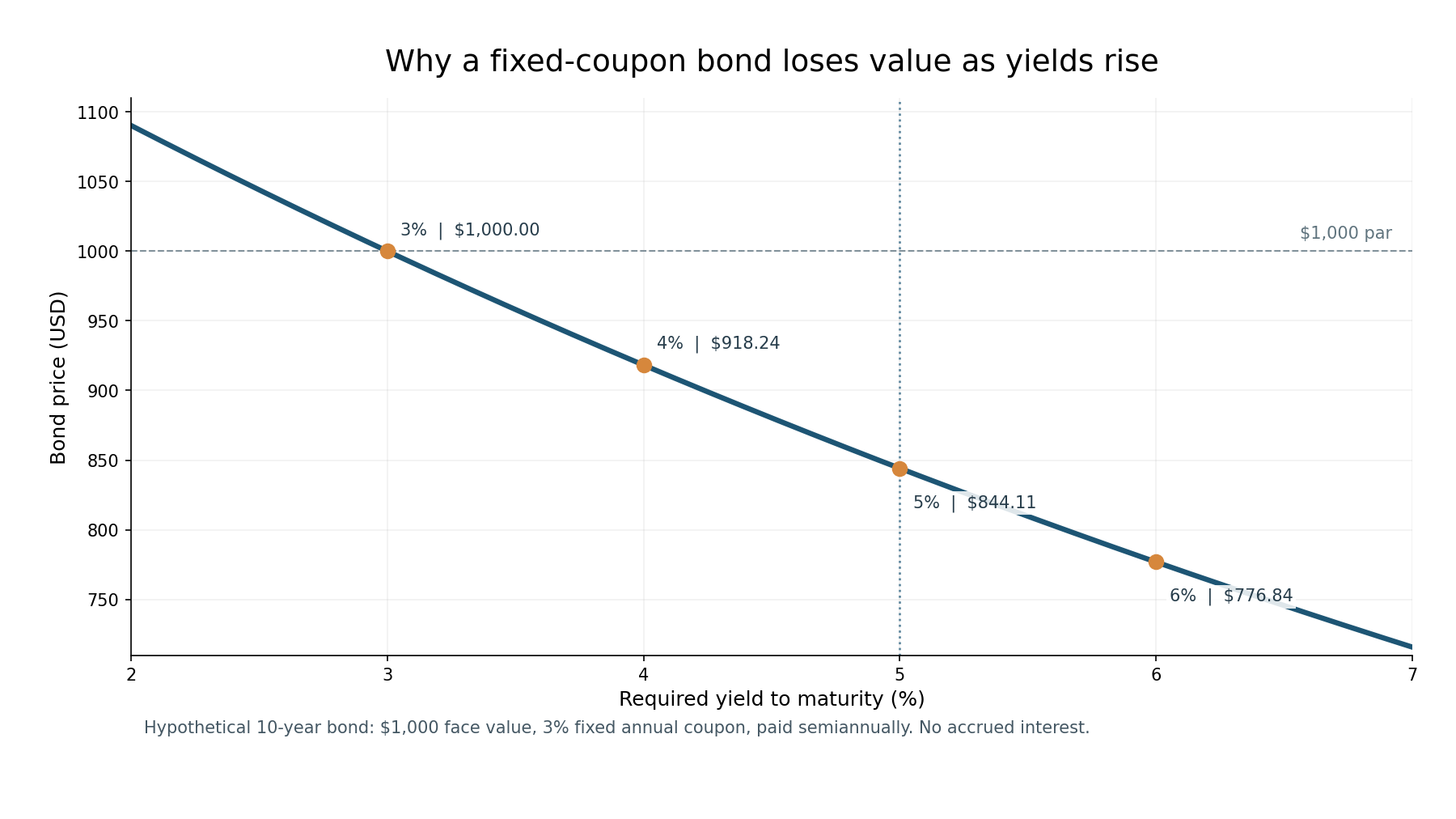
| Required YTM | Price per $1,000 par | Price vs. par |
|---|---|---|
| 3.00% | $1,000.00 | 0.00% |
| 4.00% | $918.24 | -8.18% |
| 5.00% | $844.11 | -15.59% |
| 5.10% | $837.08 | -16.29% |
| 6.00% | $776.84 | -22.32% |
The 5.10% row illustrates the arithmetic near the November 12, 2026 10-year benchmark. It does not represent an observed trade, auction price, or an actual Treasury security. In every row, the bond still pays $15 every six months. Only the discount rate and resulting price change.
Duration Measures How Sensitive a Bond Is to Yield Changes
Modified duration estimates the percentage price change for a small change in yield, holding the bond’s expected cash flows unchanged. A common approximation is: percentage price change ≈ -modified duration × change in YTM, with the yield change written as a decimal.
At a 5.00% yield, the example bond’s modified duration is approximately 8.36 years. A 1-percentage-point yield rise would suggest an initial price decline of about 8.36%. Repricing the bond exactly from 5% to 6% gives a decline from $844.11 to $776.84, or about 7.97%. The difference reflects convexity, the curvature of the price-yield relationship. FINRA’s duration guidance explains why duration is an estimate rather than a promise of an exact outcome.
With similar credit quality and coupons, longer-maturity bonds generally have more duration risk because more of their cash flows lie far in the future. Shorter-maturity securities tend to be less rate-sensitive. Lower-coupon bonds also generally have higher duration than otherwise comparable higher-coupon bonds.
What a 5% Treasury Yield Means for Bond Investors
A 5% Treasury benchmark does not mean all existing bonds now pay a 5% coupon. It means buyers’ required returns for securities with that maturity and risk profile have changed. Older fixed-rate issues can reprice without any change to their scheduled cash payments. A newly issued security can carry a coupon close to its auction yield, but individual securities may trade at premiums or discounts.
Higher yields create two different effects. Investors buying after a price decline may obtain a higher YTM, assuming future cash flows are paid. Investors who already own the bond see a lower mark-to-market value. If an investor holds an individual default-free fixed-principal bond to maturity, promised principal repayment does not depend on interim price quotations, although inflation, opportunity costs, and reinvestment outcomes remain important.
A bond mutual fund or exchange-traded fund (ETF) generally has no single date when the entire portfolio returns principal to one investor. Its holdings mature, are sold, and are replaced. Fund net asset value therefore remains sensitive to yield changes even for long-term holders, while higher portfolio yields may eventually improve future income. Interest-rate risk and credit risk should be analyzed separately.
Why Treasury Yields Also Matter Beyond Bonds
U.S. Treasury yields help anchor discount rates used elsewhere in finance. Higher risk-free benchmarks can increase the return investors require from corporate bonds and stocks, all else equal. For that connection, see how interest rates affect stock valuations and our discounted cash flow valuation guide. Inflation surprises can also alter rate expectations, as explained in our guide to inflation and technology-stock valuations.
Keep the categories distinct: the Federal Reserve’s target range is an overnight policy rate; the 10-year Treasury yield is a long-term market benchmark; the coupon is a contractual payment rate; and YTM is the return implied by a specific bond’s price and remaining cash flows.
Common Mistakes and Key Takeaways
- Confusing a yield increase with a coupon increase: a fixed coupon does not reset when market yields change.
- Treating a 5% yield as a guaranteed one-year return: YTM is conditional on cash flows and holding assumptions; a sale before maturity may produce a gain or loss.
- Ignoring duration: a 30-year bond can react much more sharply than a short-term note to the same yield change.
- Assuming government backing fixes the market price: Treasury securities still fluctuate before maturity.
- Comparing unlike securities: maturity, credit quality, tax treatment, callability, and liquidity affect quoted yields.
Bottom line: for a fixed-coupon bond, a higher required yield means a lower present value of the same future payments. That is why the hypothetical 3% bond is worth $1,000 at a 3% yield but only $844.11 at a 5% yield. The principle is durable even when the current Treasury yield moves away from 5%.
For educational purposes only; not investment, tax or career advice.