


Market-cap-weighted S&P 500 ETFs give the largest companies the largest portfolio weights. Equal-weight S&P 500 ETFs start each quarterly rebalance with roughly the same weight in every company. Both approaches invest in the S&P 500, but they create different exposures to mega-cap stocks, sectors, market cycles, and trading costs. Neither weighting method is consistently superior.
For a U.S. investor, the practical comparison is between market-cap-weighted funds such as SPY, VOO, and IVV and an equal-weight fund such as RSP. The key decision is not which ETF had the best recent return. It is how much influence you want the largest companies to have over your portfolio.
What Is a Market-Cap-Weighted S&P 500 ETF?
The standard S&P 500 is float-adjusted market-cap weighted. Market capitalization is a company’s share price multiplied by its outstanding shares; float adjustment excludes shares that are not readily available to public investors. A company’s index weight therefore reflects the value of its publicly available shares relative to the whole index.
Formula (percent of index):
Company weight = company’s float-adjusted market capitalization ÷ total float-adjusted market capitalization of index constituents × 100.
When a very large company rises faster than the rest of the market, its weight can increase automatically. A cap-weighted index does not need to sell the company just because its price went up. Its provider still adjusts for constituent changes, share counts, and corporate actions under published rules. See S&P Dow Jones Indices’ U.S. index methodology.
This structure gives successful large companies greater influence, but it also creates concentration risk. For example, State Street listed NVIDIA at 7.78% and Apple at 7.70% of SPY on October 22, 2026. Together, those two holdings represented 15.48% of the fund at that date. The weights will change with markets and portfolio updates. The SPY fund information and holdings provide an up-to-date view.
For a broader explanation of the conventional ETFs’ fund structures and trading differences, see our VOO vs. IVV vs. SPY comparison.
What Is an Equal-Weight S&P 500 ETF?
The S&P 500 Equal Weight Index starts with the same constituent companies as the standard S&P 500 but targets about 0.20% per company at each quarterly rebalance, based on 500 companies. When a company has more than one stock class, the index methodology handles those classes within its company allocation. Weights drift between rebalances as stock prices move.
The index provider confirms that the index is rebalanced quarterly. Invesco’s RSP seeks to track this equal-weight index. A company worth hundreds of billions of dollars can therefore receive approximately the same starting portfolio allocation as a much smaller S&P 500 constituent.
Equal weighting reduces dependence on individual mega-cap companies, but it is not an equal allocation to the 11 sectors, nor does it mean the holdings are small-cap stocks. It gives more influence to the smaller companies within the S&P 500. This creates a structural tilt toward smaller size and often toward value rather than momentum.
Hypothetical example: same stocks, different weights
Consider five hypothetical U.S. companies with total float-adjusted market capitalization of $1 trillion. The figures are hypothetical and illustrate the weighting calculation rather than actual ETF holdings.
| Hypothetical company | Float-adjusted market cap | Market-cap weight | Equal weight |
|---|---|---|---|
| A | $400 billion | 40% | 20% |
| B | $250 billion | 25% | 20% |
| C | $150 billion | 15% | 20% |
| D | $120 billion | 12% | 20% |
| E | $80 billion | 8% | 20% |
| Total | $1,000 billion | 100% | 100% |
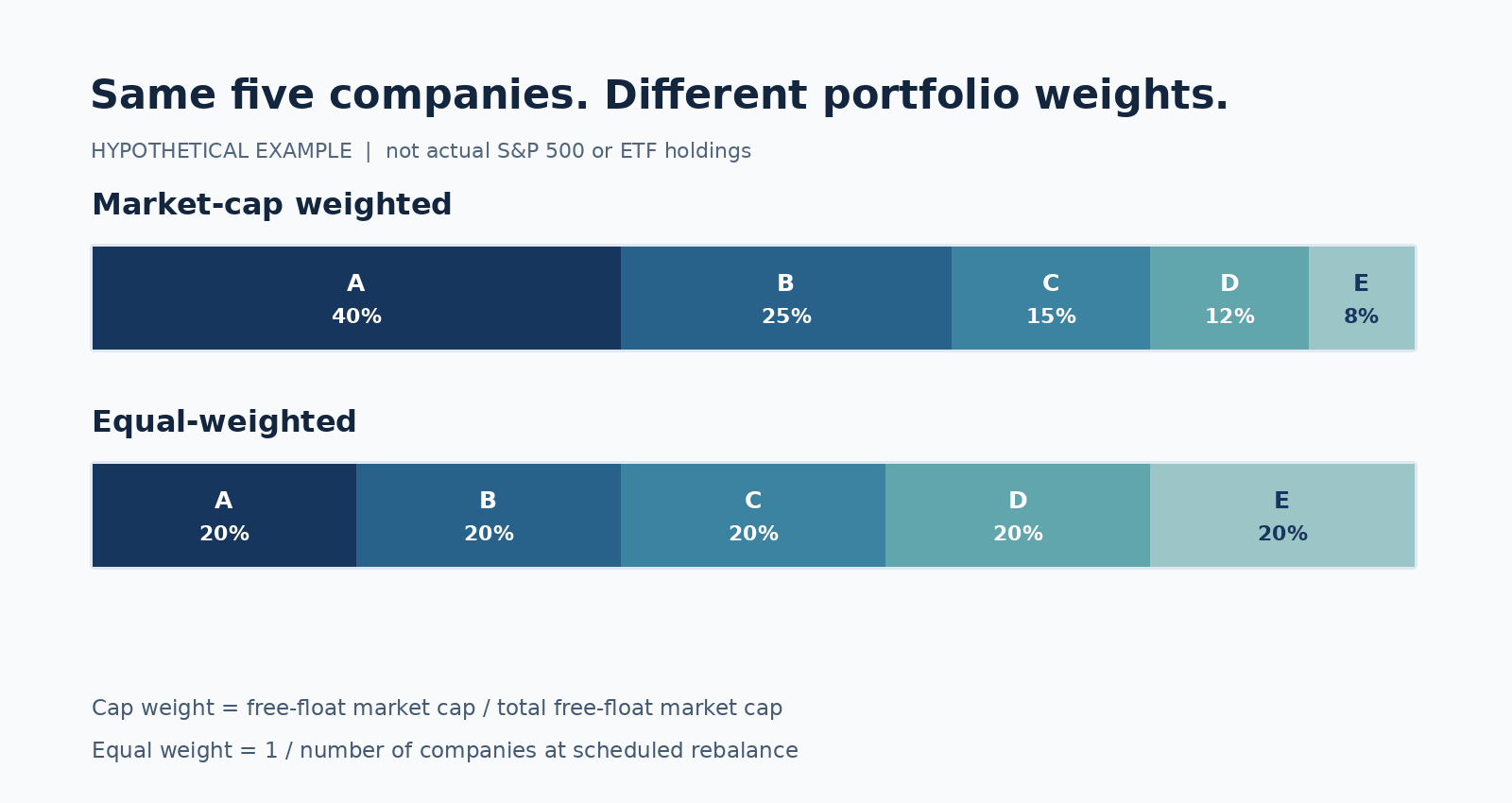
Now assume that over a single period, A gains 20%, B gains 10%, C is unchanged, D loses 10%, and E loses 20%. Assume beginning-of-period weights stay fixed, with no intra-period rebalancing, dividends, taxes, or fees.
Market-cap-weighted return: (40% × 20%) + (25% × 10%) + (15% × 0%) + (12% × −10%) + (8% × −20%) = 7.7%.
Equal-weighted return: (20% × 20%) + (20% × 10%) + (20% × 0%) + (20% × −10%) + (20% × −20%) = 0.0%.
The market-cap-weighted portfolio outperforms in this hypothetical scenario because the largest companies lead. If those company returns were reversed, the same calculation would give −7.7% for the cap-weighted basket and 0.0% for the equal-weighted basket. Weighting, not the company list, explains the difference. Actual ETF returns also reflect dividends, constituent changes, rebalancing, and fund expenses.
SPY, VOO, IVV, and RSP: Fees and Structure
The ETFs below are U.S.-listed funds. The table compares the funds’ stated annual expense ratios as of November 2026. Expense ratios may change.
| ETF | Issuer | Index tracked | Weighting method | Annual expense ratio | Approx. annual fee per $10,000* |
|---|---|---|---|---|---|
| VOO | Vanguard | S&P 500 | Float-adjusted market cap | 0.03% | $3.00 |
| IVV | iShares / BlackRock | S&P 500 | Float-adjusted market cap | 0.03% | $3.00 |
| SPY | State Street / SPDR | S&P 500 | Float-adjusted market cap | 0.0945% | $9.45 |
| RSP | Invesco | S&P 500 Equal Weight | Equal per company at rebalance | 0.20% | $20.00 |
Illustrative annual fund expense on a constant $10,000 balance, excluding changes in value, trading costs, and taxes. Expenses are generally reflected in fund NAV, not billed separately as a yearly brokerage charge. Sources: Vanguard, iShares, State Street, and Invesco.
RSP’s stated fee is 0.17 percentage points (17 basis points) higher than VOO’s or IVV’s. On a hypothetical $100,000 balance held constant for one year, that equals approximately $170 more in fund expenses, before considering any difference in holdings’ performance. An equal-weight fund must earn enough additional gross return to offset its higher costs before it can deliver a higher net return.
When Can Equal Weight Outperform Market-Cap Weight?
Equal weight may have an advantage when gains spread beyond a handful of mega-cap leaders. Because RSP allocates more to the smaller companies within the S&P 500, a broad rally led by those firms can help it relative to SPY. It can also benefit when former laggards recover after a quarterly rebalance has restored their weight.
Market-cap weight may have an advantage when the largest companies lead for an extended period. During a concentrated growth or technology rally, SPY, VOO, and IVV can benefit from their larger allocations to the leaders. Equal weighting periodically trims stocks that appreciated more and adds to laggards, so it can fall behind in a persistent momentum market.
Neither outcome is guaranteed. Equal weight changes exposure to company size, style, and sectors. Those changes can increase cyclical sensitivity and do not automatically reduce total portfolio volatility or the severity of a broad bear-market loss. The S&P Dow Jones Indices FAQ describes these factor tilts and rebalancing effects.
Does Equal Weight Really Provide Better Diversification?
It offers less concentration in the largest individual stocks at rebalancing, which is one type of diversification. It does not add entirely new companies relative to the S&P 500, remove U.S. equity market risk, or provide exposure to non-U.S. stocks and bonds.
Sector balance may also change materially. If one sector has many constituents but fewer mega-cap names, its aggregate weight can increase in an equal-weight index. Another sector dominated by a few very large companies can lose weight. Investors should therefore compare sector weights, top-10 concentration, performance during drawdowns, turnover, and valuation characteristics, not just the number of holdings.
Interest-rate changes can affect both portfolios, but not in exactly the same way. Mega-cap growth valuations are sensitive to expected future cash flows, while more cyclical companies can be sensitive to funding conditions and the economy. Our guide to how interest rates affect DCF valuation explains the discount-rate mechanism.
What Does Quarterly Rebalancing Change?
RSP and its benchmark rebalance quarterly toward equal company weights. In practical terms, the process generally sells some shares of stocks whose portfolio weights have grown and buys some shares of those whose weights have shrunk. It enforces the strategy rather than predicting which stocks will recover.
This introduces more deliberate trading than a conventional cap-weight approach. The result may include higher turnover and transaction costs, although the realized impact varies by fund and market conditions. In-kind ETF creation and redemption can improve tax efficiency, but they do not guarantee that distributions or investor-level taxes will be zero. The SEC’s index-fund guide explains costs, tracking error, and fund risks.
Which Weighting Method Should You Choose?
A market-cap-weighted fund is a straightforward choice for investors seeking inexpensive exposure to the standard S&P 500 and who accept the rising influence of the largest companies. VOO and IVV minimize stated fund expenses; SPY offers a long-established trading and options market.
An equal-weight fund can make sense for investors deliberately seeking less single-company concentration and greater participation by the smaller S&P 500 members. The trade-offs include a higher fee, greater rebalancing activity, and periods of significant underperformance relative to the standard index.
Holding both approaches is possible, but it creates a blend of the same underlying companies, not two unrelated sources of diversification. Before choosing a split, check how combined holdings affect mega-cap and sector weights, and account for taxes if changing an existing taxable position.
Frequently Asked Questions
Is RSP safer than SPY?
Not necessarily. RSP reduces concentration in individual mega-cap stocks at rebalance dates but remains exposed to U.S. equities, sectors, economic cycles, and market drawdowns. Its overall volatility can be higher or lower depending on the period.
Are equal-weight S&P 500 ETFs always better in a market recovery?
No. They may benefit if the recovery is broad and smaller S&P 500 constituents lead. They can lag when the recovery is concentrated in the largest companies.
Is buying RSP plus VOO the same as diversification outside the S&P 500?
No. The funds largely hold the same companies but in different proportions. Exposure to international stocks, bonds, or companies outside the S&P 500 requires other holdings.
Bottom Line
Market-cap weighting lets the biggest companies drive more of the index’s return. Equal weighting resets each company’s influence toward roughly the same level every quarter. For long-term investors, the decision is a trade-off among concentration, factor exposures, turnover, and costs, not a bet that one method must always win.
Last updated November 13, 2026. For educational purposes only; not investment, tax or career advice.